
For
decades, higher education has followed a repetitive structure: attending
classes, earning a degree, and then stepping into the workforce. While this
model has shaped generations of professionals, the world is evolving at a rapid
pace that traditional education systems cannot adapt to. By 2030, the
discussion about employment potential may shift dramatically, from the value of
a degree and marks in exams to the relevance of real-world skills such as
creative thinking that can solve real-world problems, collaboration with teams,
and communication skills.
Across
industries, employers are increasingly looking for professionals who can
contribute from day one. Orchid understands that practical knowledge,
adaptability, and hands-on experience are becoming more important than
theoretical understanding alone. As a result, skill-based education is
emerging as one of the most important forces shaping the future of higher
learning.
The Limits of Traditional Degrees
Traditional
degree programs have long been valued for their academic rigor and structured
learning, providing students with foundational knowledge in science and
technology and the arts.
However,
the demands of modern industries are evolving rapidly. Many graduates enter the
job market with strong theoretical knowledge but limited exposure to real-world
challenges. Employers often invest additional months or even years training new
hires before they become fully productive.
This
gap between education and employability has become a growing concern, as industries
become more technology-driven and innovation-focused, the ability to apply
knowledge practically has become just as important as acquiring it.
Recognizing
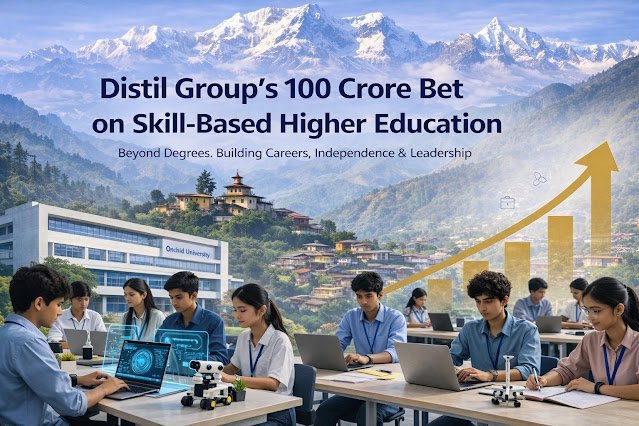
this shift, Orchid University, supported by Distil Group, is exploring
new education models that combine academic learning with real-world industry
exposure.
Why
Skill-Based Education Is Gaining Momentum
Skill-based education
focuses on preparing students for the realities of the workplace. Instead of
relying solely on classroom learning, it combines academic understanding with
practical application, project-based learning, and industry exposure.
Globally,
many education systems are moving toward this approach. Countries with strong
apprenticeship cultures have demonstrated that when students gain real work
experience during their education, they enter the workforce more confidently
and contribute more effectively.
In
India, where millions of students graduate every year, the conversation around
employability is becoming more urgent. As the economy evolves and new
industries emerge, institutions are increasingly recognizing the importance of
equipping students with skills that align with industry needs.
This
is where institutions such as Orchid University, backed by Distil Group,
are positioning themselves differently by emphasizing skill development, career
readiness, and real industry engagement as core components of higher education.
The
Learn & Earn Revolution
One of the most
promising developments in education is the Learn & Earn model.
Instead of waiting until graduation to enter the workforce, students gain
professional exposure while they are still studying.
This
approach transforms the learning experience in several ways. Students not only
understand theoretical concepts but also see how those ideas function in real
business environments. They work on real projects, interact with professionals,
and develop practical skills that cannot be learned through textbooks alone.
At Orchid
University, this philosophy forms the foundation of its academic approach.
Supported by the vision of Distil Group, the institution is exploring how
students can integrate academic learning with professional experience through
structured Learn & Earn opportunities.
Day
One Stipend: Rethinking the Student Journey
A
growing number of forward-thinking institutions are experimenting with day-one
stipend models, where students begin earning from the start of their
educational journey. This concept reflects a major shift in the philosophy of
higher education. Instead of viewing students only as learners, institutions
recognize them as emerging professionals who can contribute meaningfully even
during their training.
At Orchid
University, this approach is being explored through programs that allow
students to gain real-world experience while receiving financial support during
their learning journey. The benefits extend beyond financial support, as
students who earn while learning often develop stronger work ethics, better
time management skills, and a deeper understanding of how industries operate.
By
the time they graduate, they are not simply degree holders; they are
experienced professionals ready to take on real responsibilities.
Intergenerational,
Skill-Based, Value-Driven Learning
Education has always
been one of the most powerful drivers of social mobility. When students gain
practical skills and meaningful employment opportunities, the impact often
extends far beyond individual success.
At Orchid
University, supported by Distil Group, the vision goes beyond
employability. The institution promotes an intergenerational, skill-based,
and value-driven approach to education, where learning equips students not
only with professional skills but also with the values needed to contribute positively
to society.
By
focusing on practical capability, ethical leadership, and long-term career
development, the model aims to create graduates who are prepared to shape
industries and uplift communities.
A
New Vision for Higher Education
As the global workforce
continues to evolve, higher education institutions are being challenged to
rethink their purpose. Preparing students for examinations is no longer enough;
the goal must be to prepare them for meaningful careers. Through initiatives
supported by Distil Group, Orchid
represents
a growing movement within education that prioritizes skill development,
industry integration, and career-focused learning.
By
combining academic foundations with hands-on experience and Learn & Earn
opportunities, Orchid aims to create an ecosystem where students can develop
both professionally and personally.
Looking
Toward 2030
By the end of this
decade, the question is not raised about whether skills matter more than
degrees. Instead, the focus will likely shift to how education systems can
combine both effectively.
Institutions
like Orchid University, with the support of Distil Group, are already
experimenting with this balance, bringing together academic learning,
skill-based training, and real-world industry engagement. As industries demand
professionals who can adapt, innovate, and contribute from day one, the future
of education will likely belong to models that combine knowledge, skills, and
experience.
By
2030, the most successful graduates may not simply be those who hold degrees
but those who graduate with the skills, exposure, and confidence to lead the
future.
Websites:
Email ID:
connect@orchiduniversity.ac.in